Podcast: Play in new window | Download
If you’re a homeschool mom, I’m guessing you’ve had that little voice in your head whisper (or scream) something like:
“Am I doing this right?”
“What if they’re falling behind?”
“Maybe I’m not cut out for this…”
Yup, I’ve been there too. And honestly? That voice doesn’t have to run the show.
One of the most powerful tools I’ve discovered as a homeschool mom is deschooling. And no, it’s not a trendy buzzword meant to make your Instagram look cute (it’s actually born in the 1970s, like me). Deschooling is a highly effective tool that helps us release doubt, uncertainty, and that not-good-enough feeling that so often creeps in behind closed doors.
Why deschooling? Deschooling helps us—and our kids—to zero in on the most important elements of learning and education and to live our lives on purpose. It’s about shifting our mindset from “doing school at home” to creating a home where learning actually works—one that feels free, purposeful, and individualized for each child and for ourselves.
And one of the clearest places to see whether deschooling is already happening? In your child’s behaviour. If you’re noticing resistance, wandering, or what looks like laziness, read this first: Stop Misreading Your Child: 10 Urgent Signs They Need to Deschool Right Now.
Why Deschooling? To Help us Learn About Learning (and Living)
I’ve spent years learning about learning, learning about living with my kids, and learning about what an education even is. And you know what I’ve discovered? It isn’t at all what I thought it was.
Turns out, I didn’t need to have a teaching degree. I didn’t need to lesson plan every homeschool day. And I didn’t ever need a report card (well…except for that one year because the kids asked me for one).
What I did need was to let go of preconceived ideas about what homeschooling “should” look like—and that’s exactly what deschooling helped me do.
Over the years, I had to address:
- Boredom, both theirs and mine
- Motivation (why sometimes they couldn’t be bothered and why sometimes I couldn’t either)
- Schedules that never seemed to fit our family rhythms
- Curriculum choices that didn’t feel quite right
- Understanding the unhelpful, oxymoronic word, “homeschool”
And here’s the truth: letting go of all of that was hard. But it was also liberating. I want to share what I’ve learned so you can be at ease in your homeschool with confidence and clarity too.
What Deschooling Really Means
Deschooling isn’t a one-time fix. It’s a gentle, ongoing process of becoming who you are as a homeschool family. It’s the bridge between overwhelm and confidence, between trying to “do school at home” and actually living and learning together in a way that feels intentional and joyful.
So how long does it actually take? The honest answer might surprise you — and it’s one of the most common questions I get. I’ve written about it in depth here: How Long Deschooling Actually Takes.
When you deschool, you start noticing:
- The rhythms that work for your family, not some arbitrary “school hours”
- The ways your kids actually learn—through curiosity, play, problem-solving, and conversation
- How much learning happens when you stop forcing it and start observing it
And you begin to release the pressure. That nagging voice saying you’re not enough? It starts to quiet down. The constant comparison to other homeschool families? It becomes irrelevant.
Because you’re doing your homeschool your way. And it works.
You’re Already Out of the Box
Remember, you’re already out of the conventional education box—you’re a homeschooler! But how do you step fully out of school-ish mindsets that aren’t working for you or your kids?
It starts with asking yourself:
- What are the quiet worries behind closed doors?
- What feels off in your homeschool right now?
- Where are your kids resisting, fidgeting, or complaining?
- Are you clear about what you actually think education is?
- Is there a schooled mindset that you just haven’t shaken?
These aren’t questions to stress over. They’re prompts to observe, reflect, and take intentional action.

Why You Want to Deschool
So many homeschool moms unconsciously replicate the very system they left behind. You wanted homeschooling for freedom, flexibility, and individualization—but sometimes we fall into:
- Following rigid schedules and grade-level expectations
- Prioritizing textbooks over curiosity
- Worrying about “keeping up” instead of nurturing growth
- Feeling exhausted and questioning our choices
Deschooling frees you from all of that.
Imagine a Different Homeschool Life
Here’s what your homeschool could feel like when you lean into deschooling:
- You feel genuinely confident in your approach
- Your schedule flows with your family’s natural rhythm
- Your children’s eyes light up with authentic curiosity
- Learning happens everywhere—not just during “school hours”
- You actually enjoy your homeschool days
- Your family feels more connected and purposeful
And here’s the beauty: this isn’t wishful thinking. I’ve lived it. My kids have lived it. And countless moms I’ve coached have experienced it too.
How to Start Deschooling
If you’re ready to start, I’ve created some free resources to help you:
- Deschool Training: A step-by-step introduction to deschooling your homeschool mindset
- 5-Day Deschool Challenge: Take it at your own pace and reflect on what really matters
- Playlist on Deschooling for Moms: Short, actionable lessons to shift your perspective
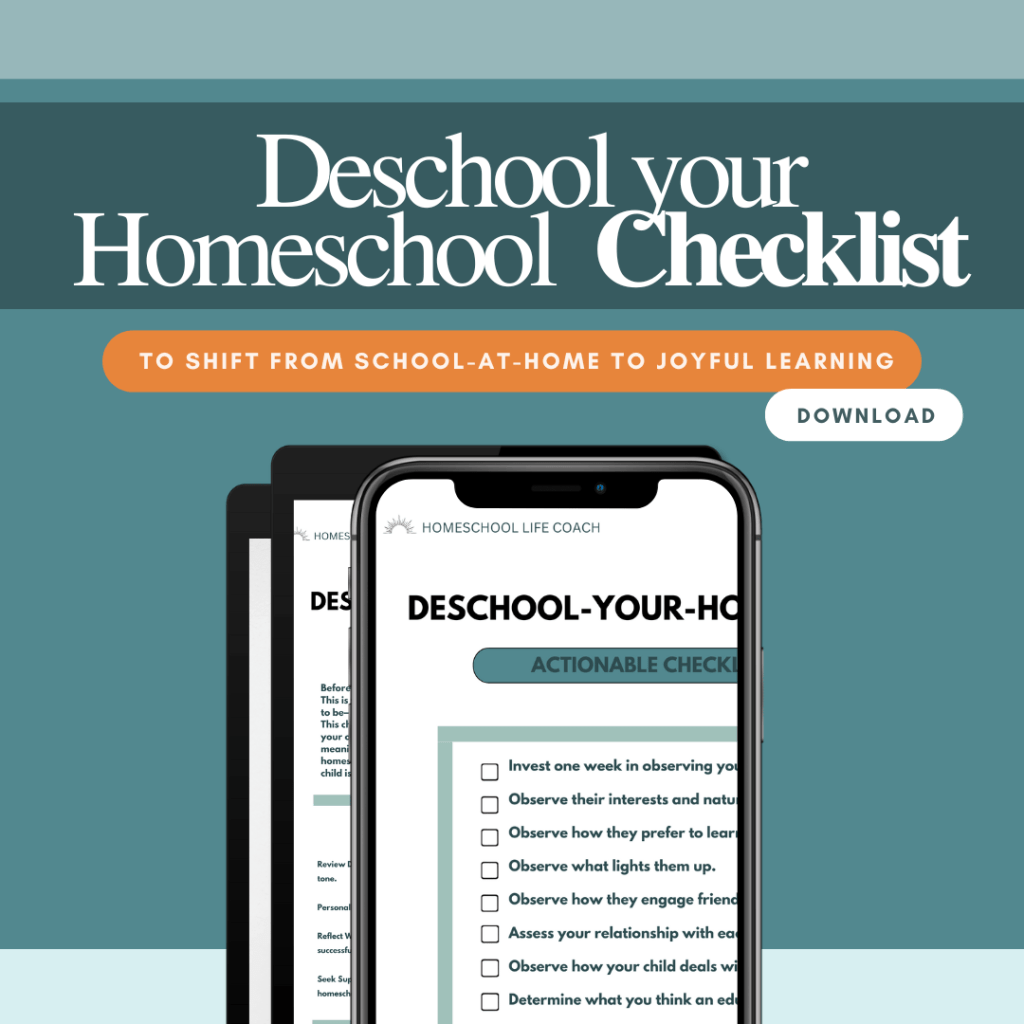
- Deschool Your Homeschool Checklist: A simple, printable guide to get started today
Each of these tools helps you:
- Identify which school mindsets are causing unnecessary stress
- Gain clarity on what truly matters in your family’s educational journey
- Release unrealistic expectations that drain your energy
- Create more genuine connection time with your children
- Walk away with an action plan to immediately transform your homeschool atmosphere
Your Homeschool, Your Way — With a Little Coaching from Me
Read it like a book, listen like a podcast, and join me in the comments for hands-on coaching in the Deschool Your Homeschool course!

Deschool your Homeschool Coaching Course
Transform your homeschooling experience with our ‘Deschool Your Homeschool’ course.
Tailored for homeschool mamas seeking freedom and purpose, this self-directed journey breaks free from traditional constraints, fostering confidence and delivering a personalized, enjoyable education.
For just $77, enroll now and reimagine your homeschool life with this transformative and empowering course.
A Few Practical Deschooling Tips
Here are some ideas I’ve used in my homeschool:
- Observe, Observe, Observe: Watch how your kids learn and what sparks their curiosity.
- Follow Interests (Yours and Theirs): Don’t be afraid to let your passions mix with theirs.
- Honor Rhythms: Wake times, outdoor time, reading, and creative work all have their own flow.
- Add Your Kind of Fun: Infuse memories, experiences, and joy into how learning happens.
- Outsource & Community: You don’t have to do everything yourself; bring in experts, friends, and community experiences.
- Each Child is Unique: No two of my four kids have the same homeschool experience—and neither do yours need to.
Lean into child-inspired learning and fill your time with what matters most. You’ll notice less worry about what’s “missing” and more joy in what’s happening.
What Happens After You Deschool
When you release the limiting schooled mindset, you can:
- Shift your mindset to release old-school expectations
- Create a homeschool that genuinely reflects your family’s values
- Support your children’s natural learning process with confidence
- Find joy in the homeschool journey instead of constant doubt
- Focus on meaningful connection instead of arbitrary checkboxes
- Trust yourself as your children’s best educational advocate
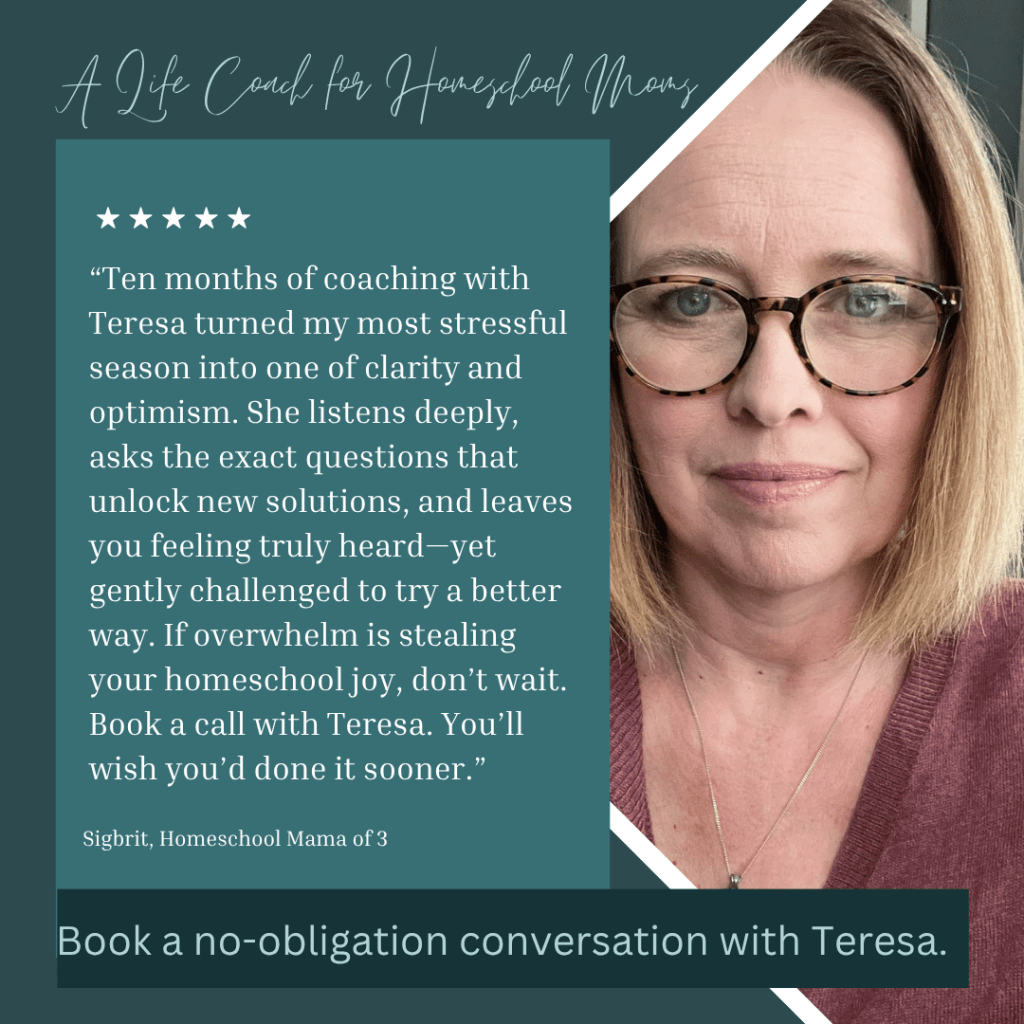
Whitney, a mom I coached, said it perfectly:
“I needed to figure out how to meet my son’s needs in our homeschool and how to incorporate service back into my life. Coaching was helpful in ways I wasn’t expecting. I feel more confident in what homeschooling looks like within my home. It will always be evolving, but I feel more at peace. I am a better detective with my kids to see what they value and care about. I see how my relationship with myself impacts my relationship with my daughter in particular.”
This is what deschooling does—it’s not about perfect schedules or curriculums; it’s about connection, clarity, and confidence.

Deschool your Homeschool Journaling Workbook
The Deschool Your Homeschool Journaling Workbook is a self-coaching tool designed to help you redefine your homeschooling journey with clarity and confidence. Through thoughtful prompts and guided exercises, this workbook empowers you to:
You Can Do This
You’re not behind. You haven’t messed this up. You’re simply being invited to reset—with intention.
Deschooling is a highly effective, gentle tool to release doubt and uncertainty, and it helps you create a homeschool that works for your family on purpose. You don’t need a teaching degree, you don’t need to plan every single day, you don’t need to check every box. You just need to begin.
And if you want some help getting started, I’ve put together my Deschool Your Homeschool Checklist, a simple tool to help you:
- Identify the school-y mindsets holding you back
- Gain clarity on what really matters
- Build more connection with your children
- Create a homeschool plan that feels free, purposeful, and individualized
Grab your checklist today and start shifting from doing school at home to learning that fits your family.
Want to Go Even Deeper?
Remember: You’re not alone in this homeschool journey. You’ve got what it takes to show up whole, grounded, and confident—for yourself and your family.
And if you’re ready to go deeper, book your free Aligned Homeschool Reset session—the link is in the show notes. Until next time, take care of yourself, nurture that nurturer, and keep leading with confidence, clarity, and presence.
People also ask:
- Join the Deschool your Homeschool Challenge
- Self-Care & Deschooling: Is there a Helpful Connection?
- How to Use the Practical Deschool your Homeschool Checklist
- What do homeschoolers want to deschool from: let’s get specific
- how to deschool 101
- How my story of deschooling brought more freedom & purpose
- Deschooling and Life Purpose: Is there a connection?
- Is deschooling a fad or is it here to stay?
- 7 Important Reasons for Project-Based Homeschooling
- How to Know if Deschooling is Right for You: 7 Signs you Need to Deschool
- Breaking Free: How Deschooling Helps You Live a Purposeful Life
- How to practically deschool your homeschool mindset
- Why do you want to deschool? Clarify before you begin.
- Overcoming Imposter Syndrome: How to Build Confidence as a Homeschool Mom
- Get free Deschool Coaching for More Freedom & Individualization
- How my story of deschooling brought more freedom & purpose
- Do you offer one-on-one coaching to deschool?
Subscribe to the Homeschool Mama Self-Care podcast
Call to Adventure by Kevin MacLeod
Link: https://incompetech.filmmusic.io/song/3470-call-to-adventure
License: http://creativecommons.org/licenses/by/4.0/
